
The Infrastructure Behind the Money Upgrade: Introducing G3
Unveiling the sequencer for real-time, global onchain finance.

Today, we’re unveiling Conduit G3, the sequencer for real-time, global onchain finance.
Some of the most important onchain applications still don't run the way they should.
Conduit G3 is built to change that. It enables real-time onchain applications to scale without hitting execution limits, with the speed, responsiveness, and flexibility required for systems such as payments, DeFi markets, tokenized assets, and consumer apps.
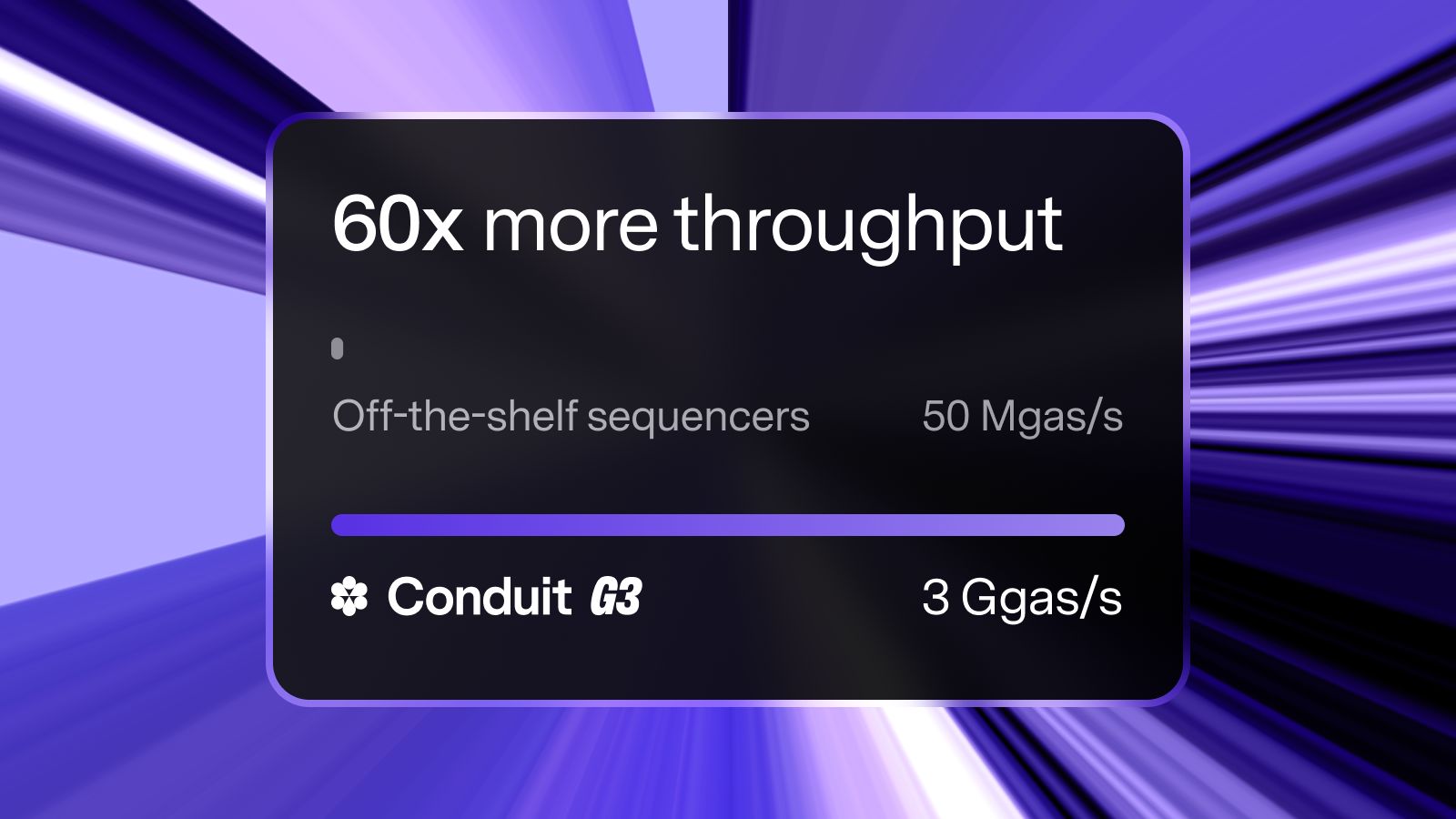
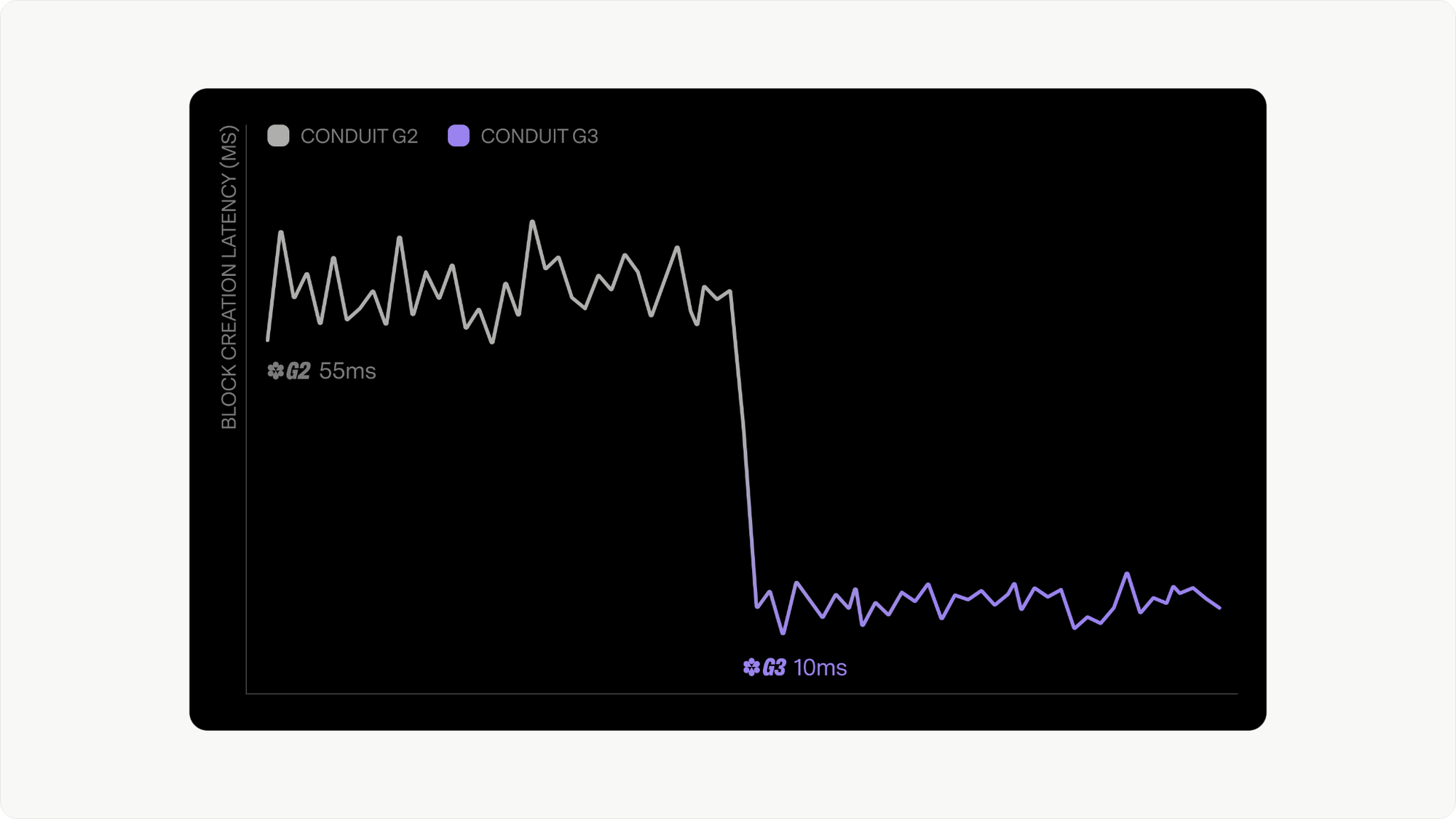
Through a new execution architecture, G3 delivers 3 Ggas/s of throughput, 30x higher than G2 and 60x more capacity than off-the-shelf sequencers, while cutting execution latency to ~10ms, over 5x lower than G2.
Built for the world’s most powerful applications, G3 is live and available today.
Where current systems fall short
As applications gain users, execution becomes the limiting factor. Systems begin to hit compute ceilings, latency becomes more noticeable, and performance under load starts to lose consistency. These constraints typically emerge once applications reach high usage, especially in systems that depend on sustained transaction volume or fast confirmation.
When execution cannot keep up, the impact is immediate. Applications slow down under load, confirmation times increase at the moments that matter most, and user experience becomes less reliable. System behavior becomes harder to predict in production, which directly affects categories such as payments, onchain trading, and interactive applications where responsiveness and reliability are essential.
At the same time, infrastructure becomes harder to evolve. Most execution environments today are built on Geth, where customization introduces operational overhead and slows iteration. As systems grow, adapting infrastructure to specific application requirements becomes increasingly difficult.
What this stage requires
As onchain systems begin to support real-world financial use cases, a gap emerges between what these applications require and what existing execution environments can provide.
Supporting this next stage requires infrastructure that can sustain execution under continuous demand, deliver low-latency responsiveness, and maintain consistent performance as usage increases. It also requires the ability to adapt execution to different application requirements without introducing additional operational complexity.
This is also the standard required for financial systems to operate fully onchain, where money moves, settles, and updates in real time.
Introducing G3
G3 was built to support this stage of growth.
It is Conduit’s next-generation sequencer, designed to sustain high execution performance under real demand while preserving verifiability. It delivers approximately 8× the performance of G2 and introduces a more flexible execution architecture built on Reth, a Rust-based Ethereum client designed for efficiency and modularity.
G3 is designed to address three requirements that emerge as systems scale: the need to process more computation, the need to reduce execution latency, and the need to adapt infrastructure to different workloads without increasing operational complexity.
Scale without hitting execution limits
G3 increases the amount of computation that can be processed onchain, allowing systems to grow without running into execution ceilings.
Compared with G2, chains powered by G3 can sustain up to 30x higher throughput under continuous demand, supporting more complex applications and higher transaction volumes. That same performance step-change gives G3 up to 60x more execution capacity than off-the-shelf sequencers.
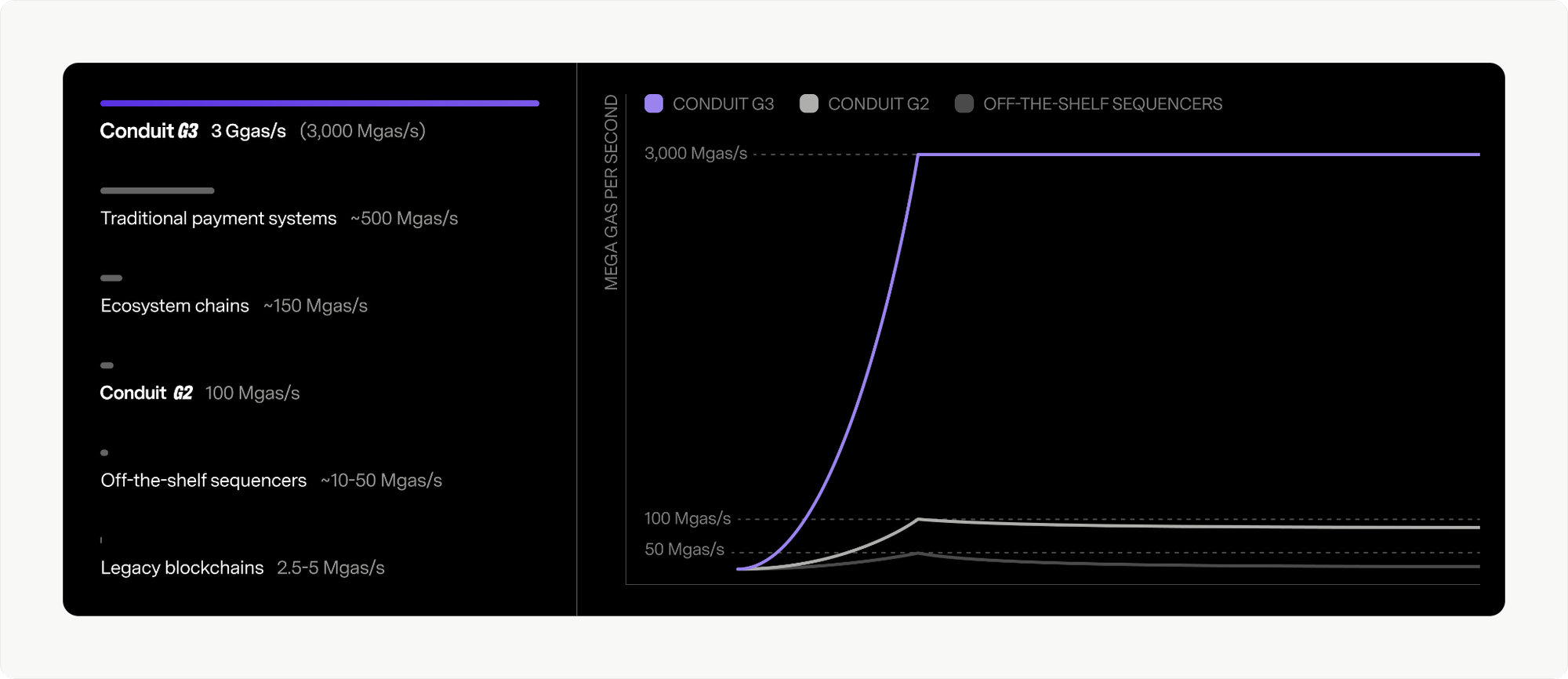
This increase in execution capacity translates into real-world throughput. Depending on the transaction type and workload characteristics, G3 can support up to 10,000 transactions per second. This level of throughput is required for systems such as onchain markets and high-volume payment flows
This upgrade is what enables the transition from static financial systems to programmable, real-time money.
Enable real-time user experience
G3 reduces execution latency to the 10-millisecond range using Flashblocks, enabling almost instant confirmation and more responsive interactions.
That represents a 5× reduction in transaction latency compared to G2. This gives applications tighter feedback loops and more reliable responsiveness in workloads where execution speed materially affects product performance, including payments, trading systems, and interactive environments.
Adapt execution to application needs
G3 introduces a modular execution approach that allows infrastructure to be tailored to specific application requirements.
Built on Reth, G3 benefits from a more efficient and flexible execution engine than traditional Geth-based systems. Its architecture enables tighter control over execution, improved performance under sustained load, and easier customization without maintaining separate forks.
This reduces operational complexity while allowing systems to evolve as requirements change.
Don’t let success be your bottleneck: Get 20x the performance of leading chains
Start building with G3
Execution performance is becoming a defining factor in how chains are built and selected.
If you are building applications where throughput, latency, and execution reliability matter, we would like to work with you. Learn more about the G3 sequencer here.
* Comparison note: Figures include estimated equivalents for traditional payment systems and are directional due to different underlying architectures.