
Ronin Network Case Study: Migrating a Live L1 to an Ethereum L2 and Reducing Network Costs

The Ronin team wanted to reduce internal overhead on their chain, so they migrated a live sovereign Layer 1 with real users, real assets, and an active validator set to an Ethereum L2. Conduit designed and executed the migration end-to-end, bringing the chain back up in under 6 hours, against a 12-hour initial target time and without any issues.
This is the largest state migration ever executed, at a third of Ethereum's size. Here’s why Ronin chose Conduit to lead it, how it de-risked the migration, how it saved costs ($40 million), and what to consider if you’re weighing the same decision.
Why migrate?
Ronin is the chain home to Axie Infinity, Pixels, Cambria, Angry Dynomites, and many other games. Ronin captured a portion of the growing video gaming industry, worth $200 billion+, by processing approximately $4.2 billion in revenue through Axie Infinity alone. Ronin wanted to grow its ecosystem and offer stronger security and faster transactions for end users.
Before the migration, the Ronin team's infrastructure demands had become a blocker. Running a sovereign L1 meant building an in-house infrastructure and protocol team and absorbing the operational weight of keeping a chain alive. The chain needed significantly higher throughput and sub-second latency for real-time gaming experiences, underpinned by scalable infrastructure that could meet future demands.
Ronin offloaded that work to Conduit, leveraging its Professional Services (system design, deployment, custom integrations and migrations) and Enterprise Solutions (G3 sequencer, ZK proving, RPC) as its specialized infrastructure partner. This let them cut costs and redirect engineers to higher-impact work.
If that trade-off sounds familiar, it’s because every blockchain company eventually faces it. In a traditional sense, it is similar to shifting from running your own data center to using a managed cloud. While the infrastructure still has to be world-class, your team shouldn’t operate it alone.
Choosing Conduit as an infrastructure partner
The Ronin team’s goal from the outset: become the premier blockchain for gaming. A robust chain that meets developer demands and delivers high performance is critical to achieving this goal. Find an infrastructure partner to help deliver a full migration to an Ethereum L2, moving a state a third the size of Ethereum, with minimal downtime and impact to end users.
The Ronin team came into the migration with a clear understanding of what they needed. Conduit was the team that could engage Ronin’s engineers at their level. Instead of waiting for contracts to close, Conduit brought a concrete, detailed migration plan up front and ran testnet simulations early, giving the Ronin team real confidence in the approach before committing a single mainnet block.
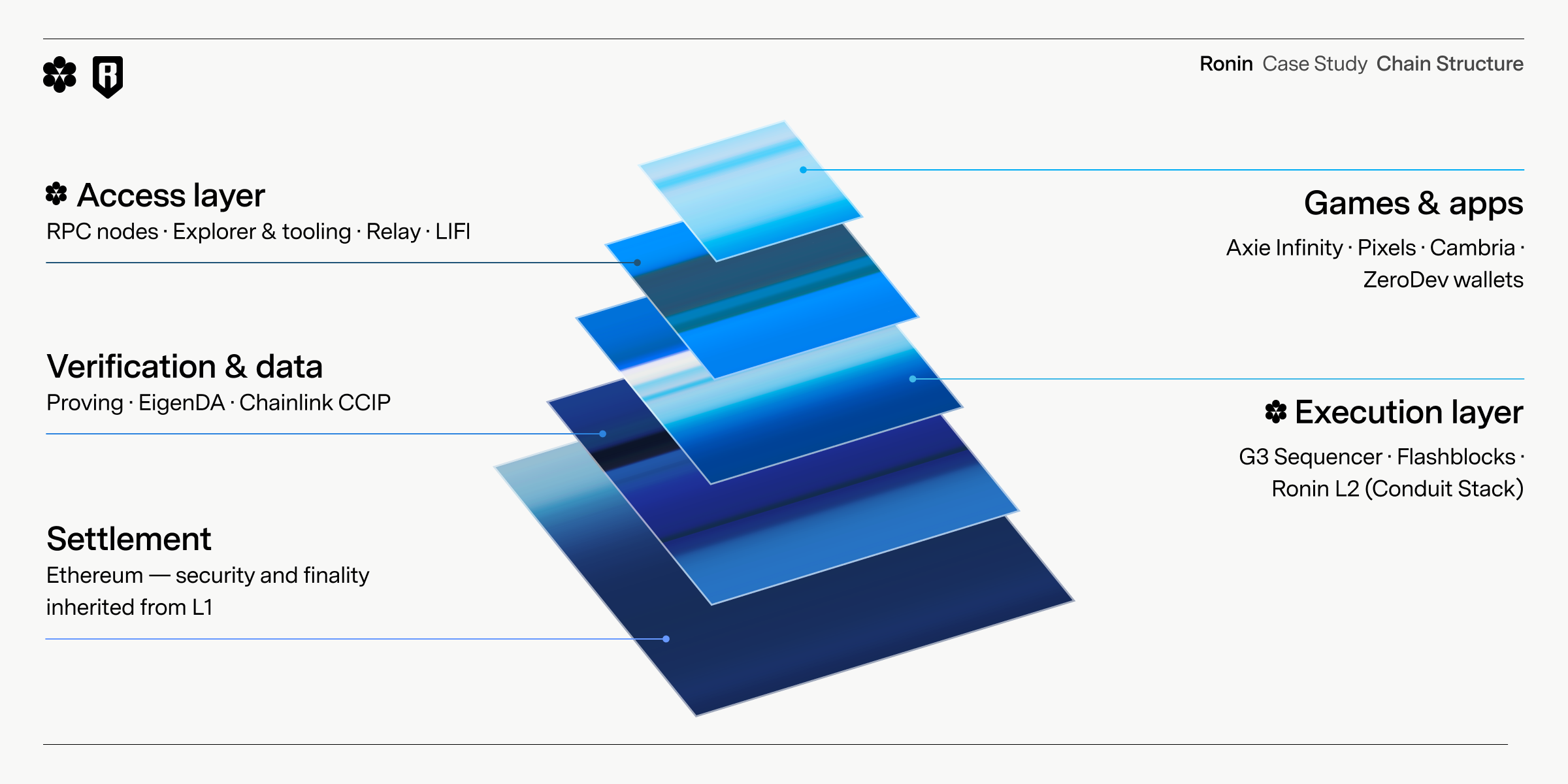
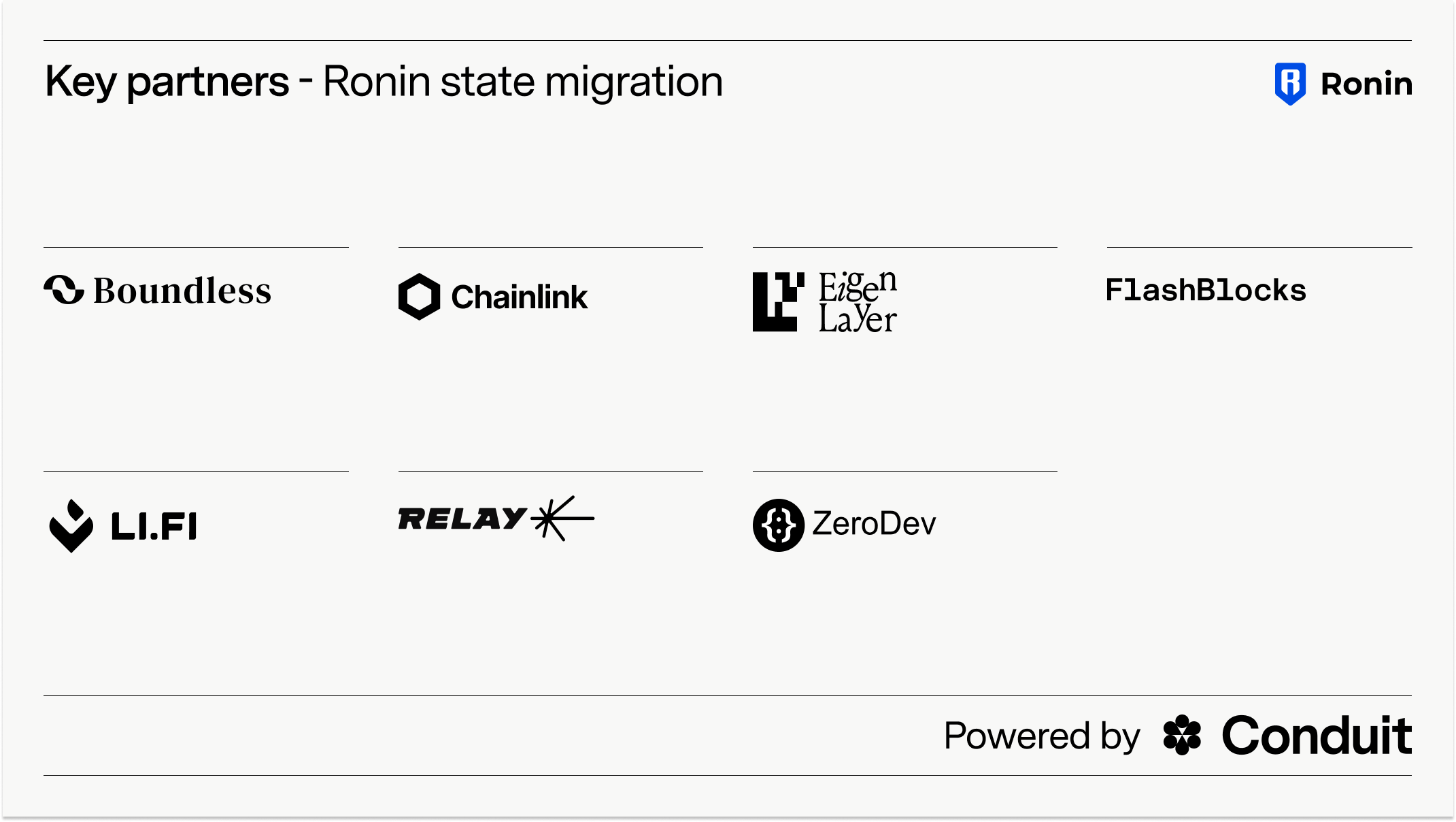
In addition, the architecture brought some of the strongest teams supporting the Ethereum ecosystem:
- Eigen DA: data availability
- Chainlink: covering CCIP for cross-chain messaging
- Relay Protocol: for cross-chain UX
- Lifi Protocol: enabling bridge routing
- ZeroDev: embedding account abstraction
- Flashblocks: sub-200ms blocks
- Boundless: ZK proving infrastructure
That combination of expertise, architectural orchestration and demonstrated capability is what separated Conduit from other providers in the marketplace.
Running the migration
Conduit ran the migration embedded with Ronin’s engineers, as the single accountable owner of the outcome. Ronin also expected to lose no transaction history, with records preserved on legacy nodes.
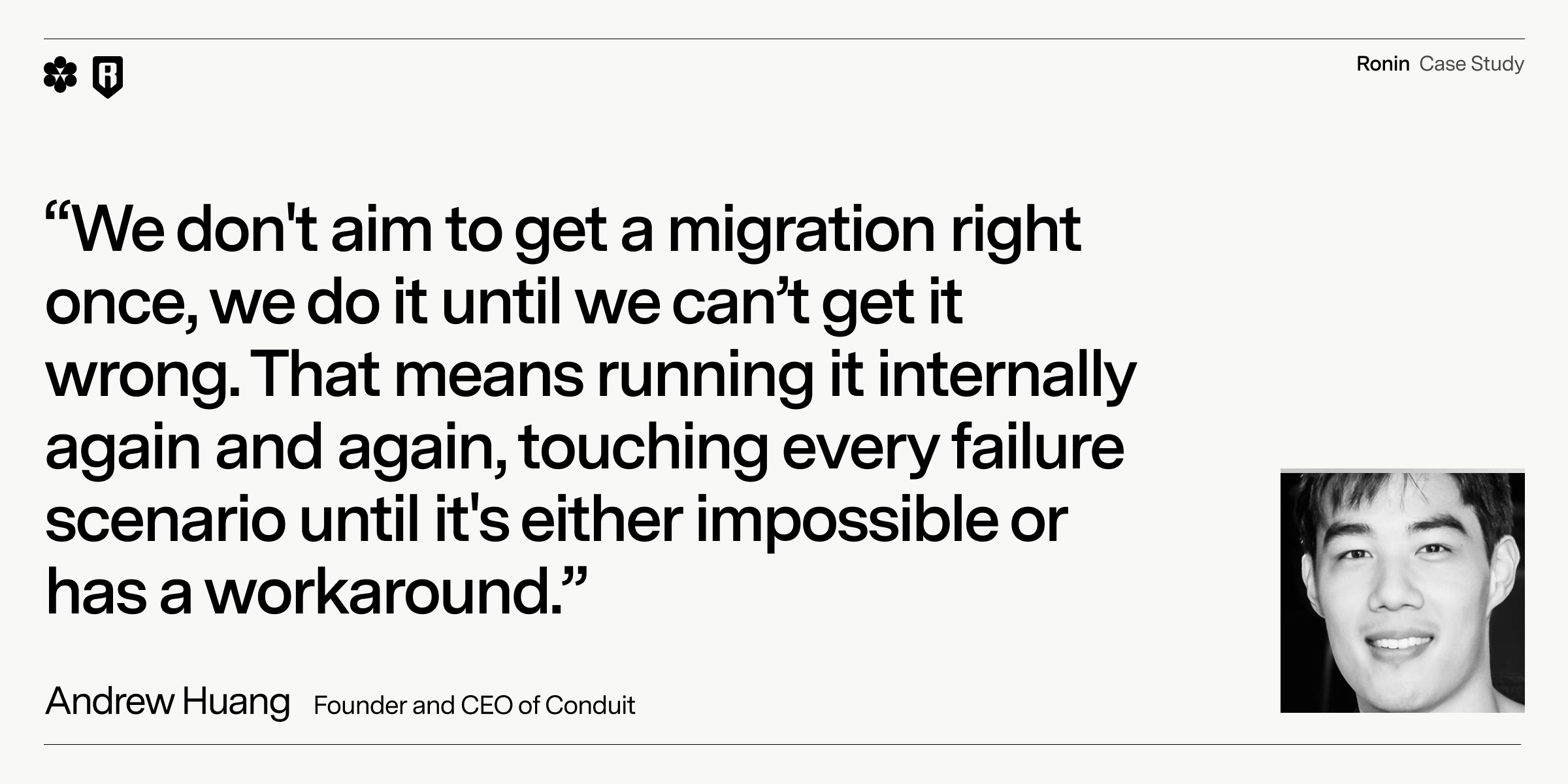
The chain needed modifications before it could move; the two teams designed and built them together. Conduit then conducted independent dry-run migrations on testnet in isolation and repeated them until the results left no room for error.
Ronin validated each test network independently before the teams agreed on a mainnet date. Conduit designed and led the migration. What began as an intense, team-led effort is now a systematized, repeatable playbook for handling all manner of chain migrations.
De-risking the migration
The defining risk is irreversibility: once you stop a chain and start a new one, there’s no clean undo. Restarting the original chain exists on paper as a fallback, but is not realistic. The migration had to be right the first time, in production.
The team worked through every failure scenario before charting a path to mainnet, either engineering a workaround or eliminating the failure mode outright. The one risk Conduit couldn’t fully own sat with Ronin’s validator set. Because a sovereign L1 doesn’t control every node in its network, Conduit scoped the residual risk precisely and ensured both teams understood exactly what it was.
To ensure nothing was lost, Conduit used state-root verification, a cryptographic proof that the chain’s entire database was identical, bit for bit, before and after the migration.
End Results & Key Stats
Ronin budgeted 12 hours of downtime, however, the chain was back up in under 6 hours.
Deliberate and expert engineering cuts user-facing downtime by more than half. For a chain with live users and assets, that difference is the whole game for an established team like Ronin.
Below are other key stats Ronin were able to accomplish as a result of the migration:
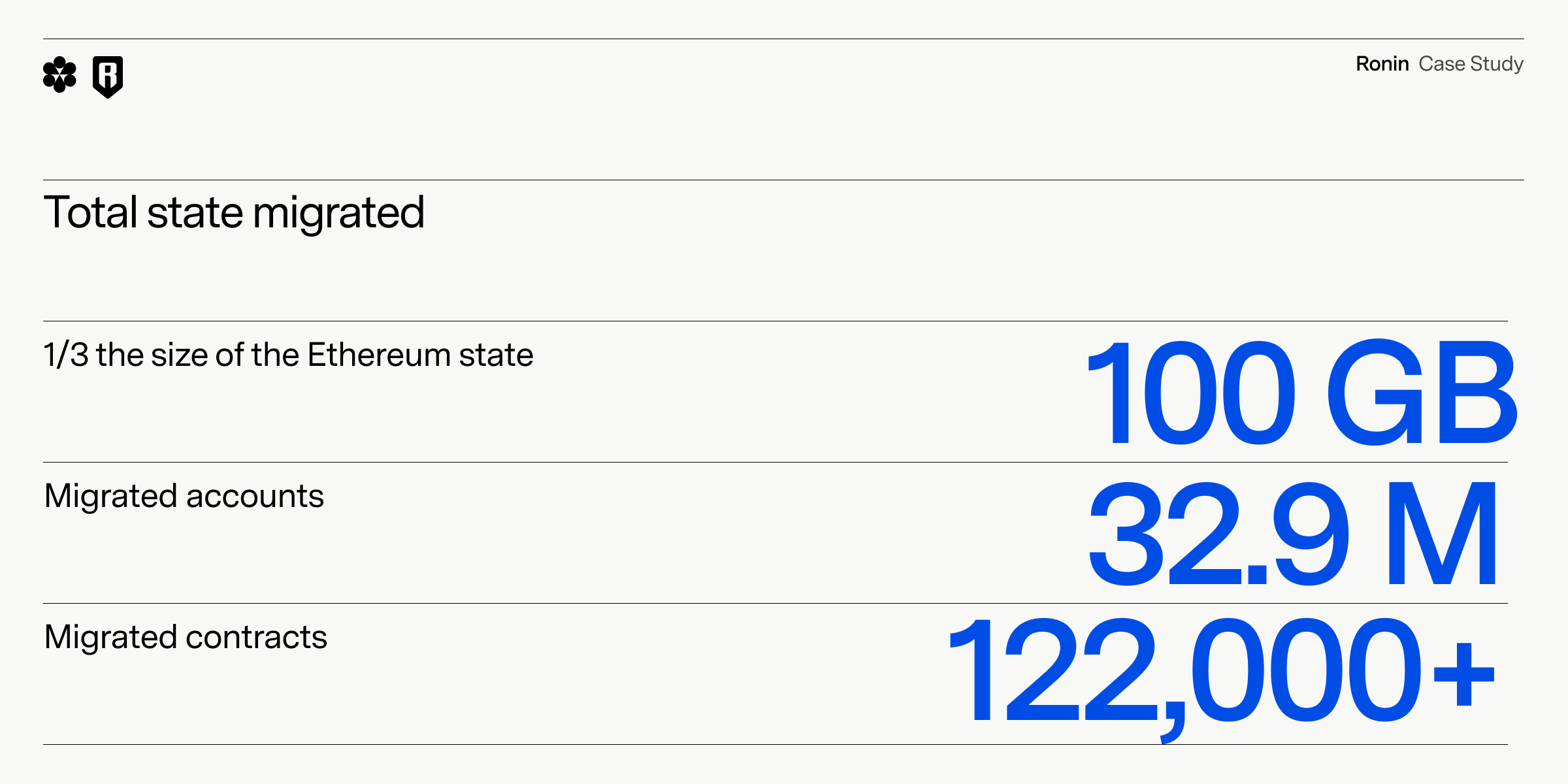
- Total state migrated
- 100GB (1 third the size of the Ethereum state)
- 32.9 million accounts
- 122,000+ contracts
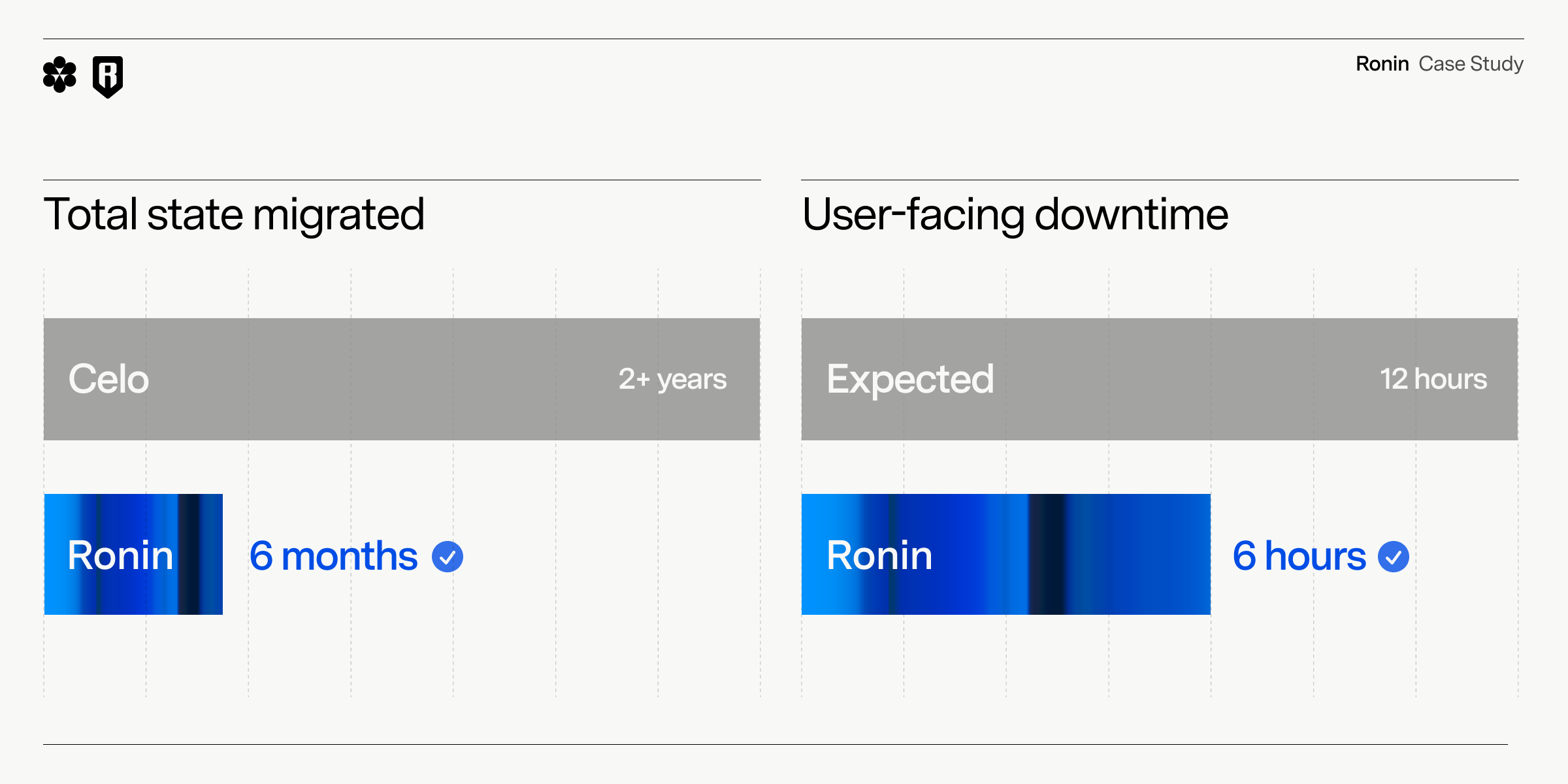
- User-facing downtime
- Expected 12 hours of downtime; Ronin experienced only 6 hours of downtime
- Total time of the migration
- For example, Celo’s comparable L1-to-L2 migration ran for nearly 2 years; Ronin’s migration took 6 months
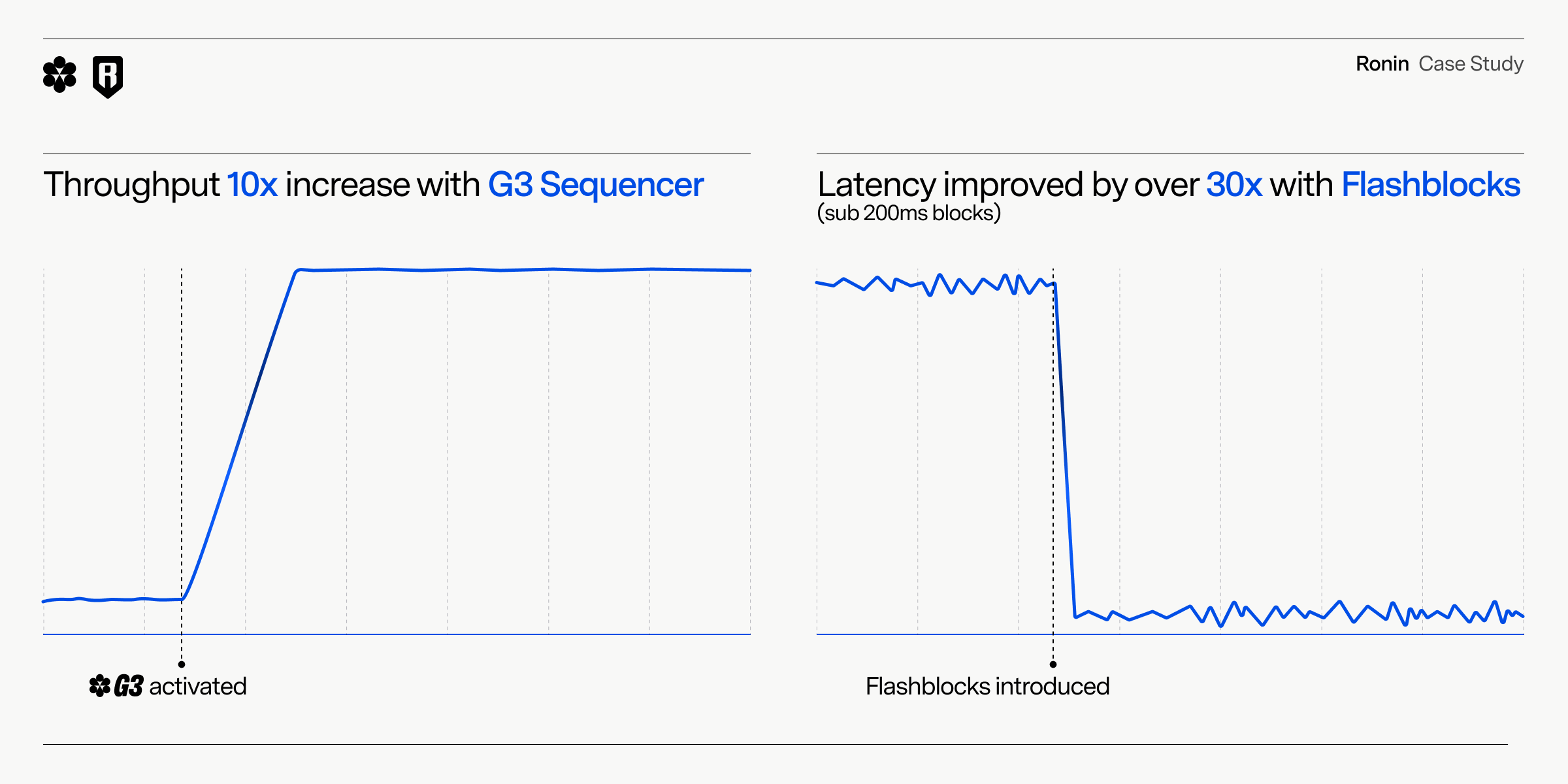
- Post-migration throughput
- Throughput 10x increase with G3 Sequencer
- Latency improved by over 30x with Flashblocks (sub 200ms blocks)
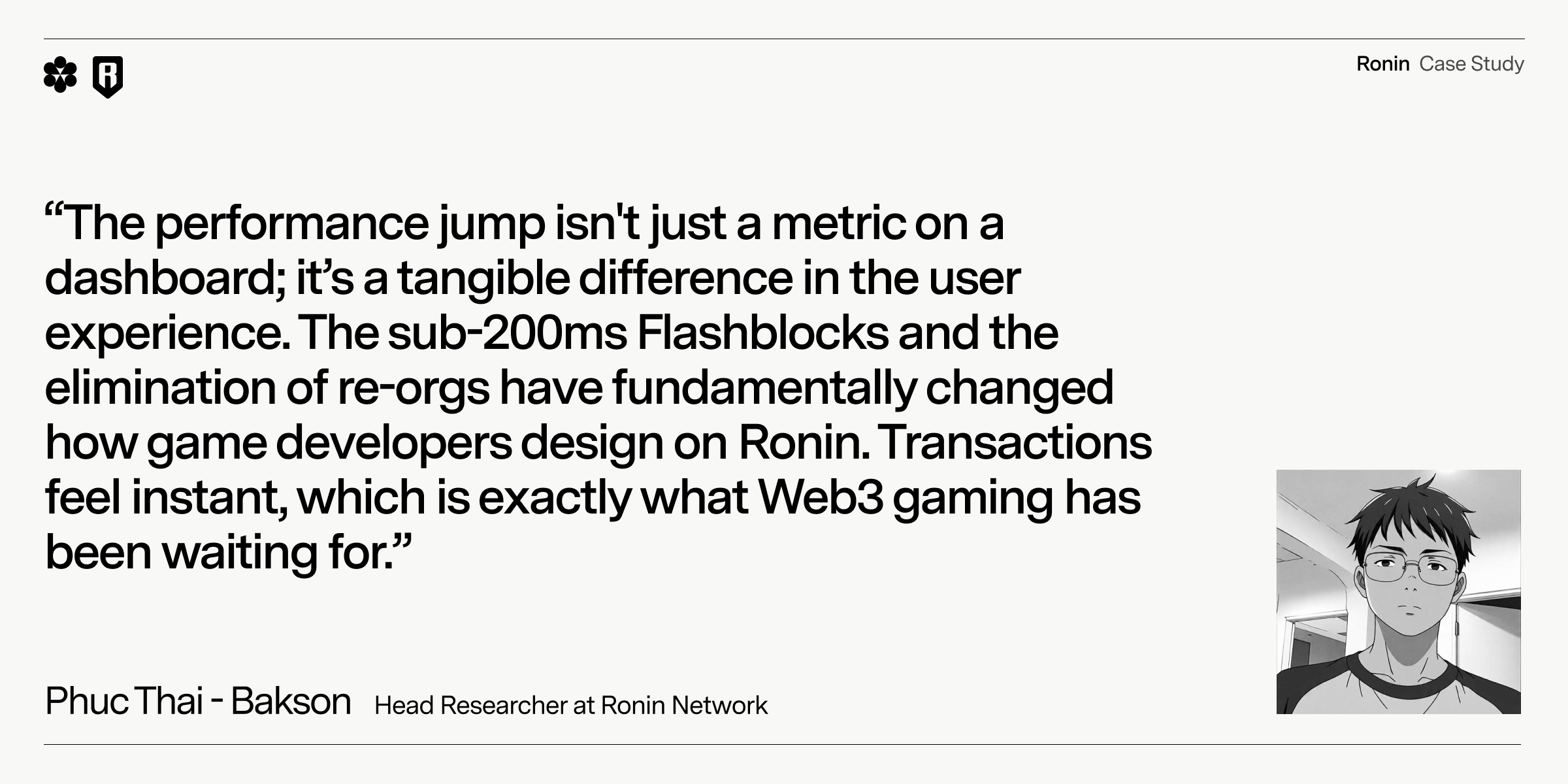
- No reorgs vs 3s block times and waiting for 2 confirmations
Post Migration Path
Conduit now runs Ronin’s full infrastructure (chain infrastructure, RPC, and tooling), all hosted with one provider, replacing multiple vendors and billing lines. With the weight of running a chain now lifted, the Ronin team can focus entirely on accelerating its product and distribution.
In addition, the Ronin team was able to benefit from:
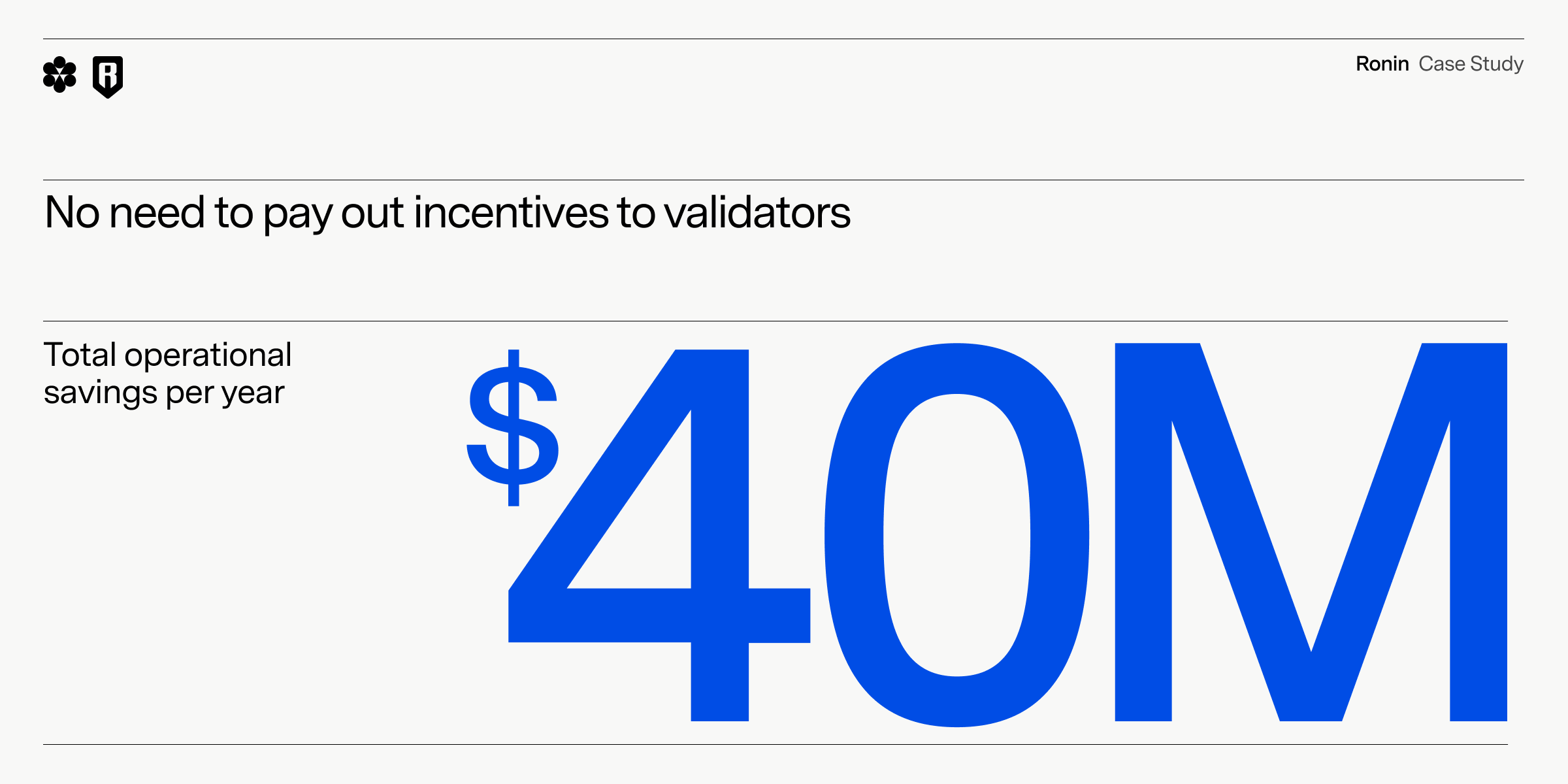
- No need to pay out incentives to validators, which was around $40 million per year
- Reallocate internal engineers to other key projects instead of funding a dedicated in-house chain update engineering team (typically 5-10 engineers)
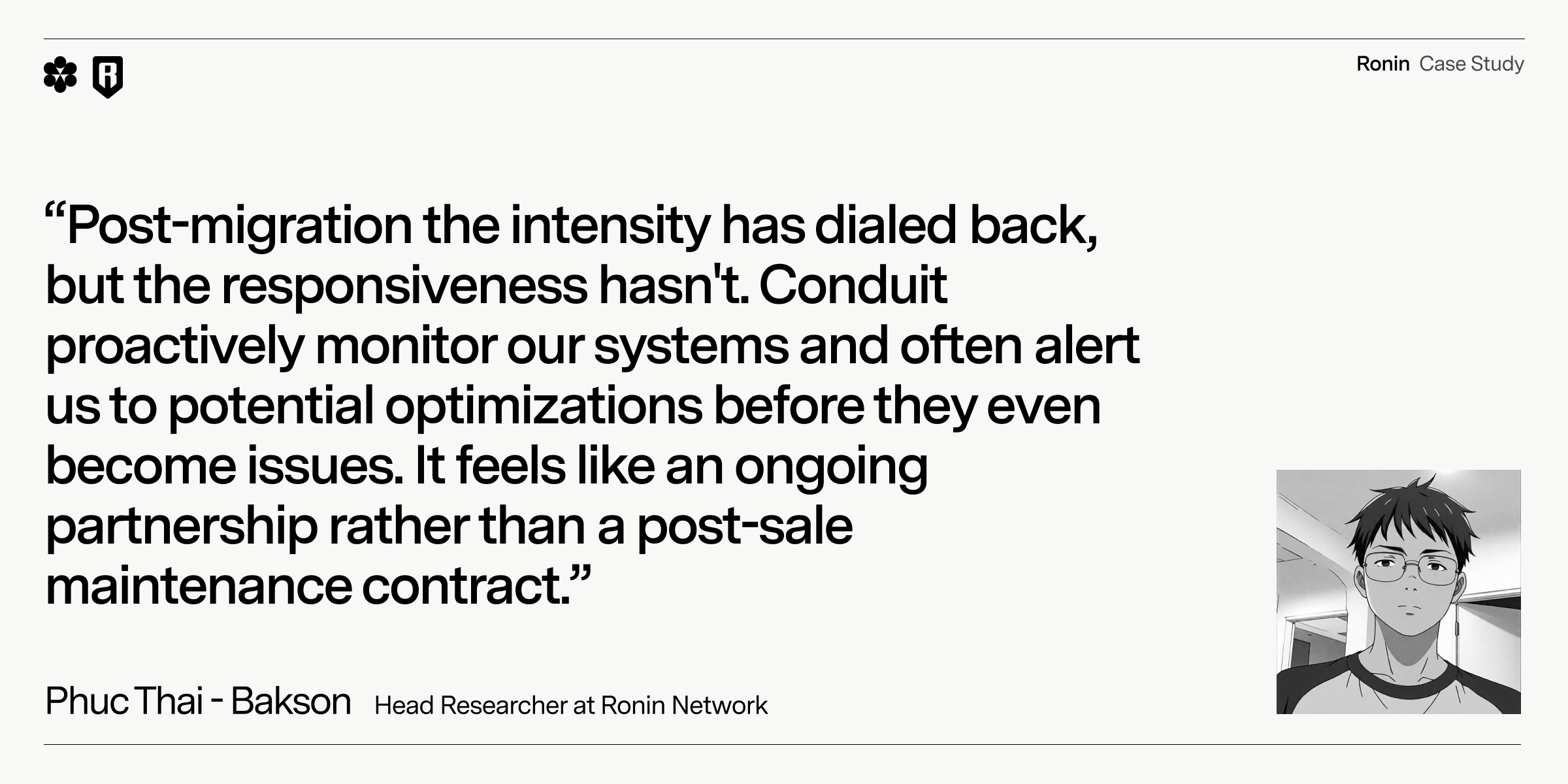
- Consolidation of vendors for chain, RPC, explorer, and other key infrastructure
That’s the part that applies to any enterprise or institution weighing the same move. The migration is one hard, visible moment. The lasting value is never having to run the infrastructure at scale again.
Key Takeaways
The Ronin migration proves Conduit adds value to enterprise teams across the full lifecycle of a chain. Conduit developed the playbook, orchestrated the migration, configured the chain and provided ongoing maintenance.
If you’re considering a chain migration or leveraging our Professional Services and Enterprise Solutions, let’s start with a conversation about your needs. Let us know what you’re running and where you want to be, and we’ll come back with a concrete, production-ready plan.
Want to discuss your migration options? Contact our team today.