
Ethereum Fusaka Upgrade: EIPs Cheat Sheet
Fusaka is a safety-first scaling release that tightens gas economics, streamlines networking for node operators, and sustainably increases rollup and L1 throughput.

Fusaka is a safety-first scaling release that tightens gas economics, streamlines networking for node operators, and sustainably increases rollup and L1 throughput. Mainnet activation is scheduled for December 3, 2025, with follow-on BPO adjustments to blob capacity shortly after.
In this guide, the Fusaka EIPs are organized by functional purpose so readers can scan what matters to them: Scaling and DA, Gas economics and block sizing, Validator UX, EVM and cryptography, and Networking and ops.
Scaling and DA
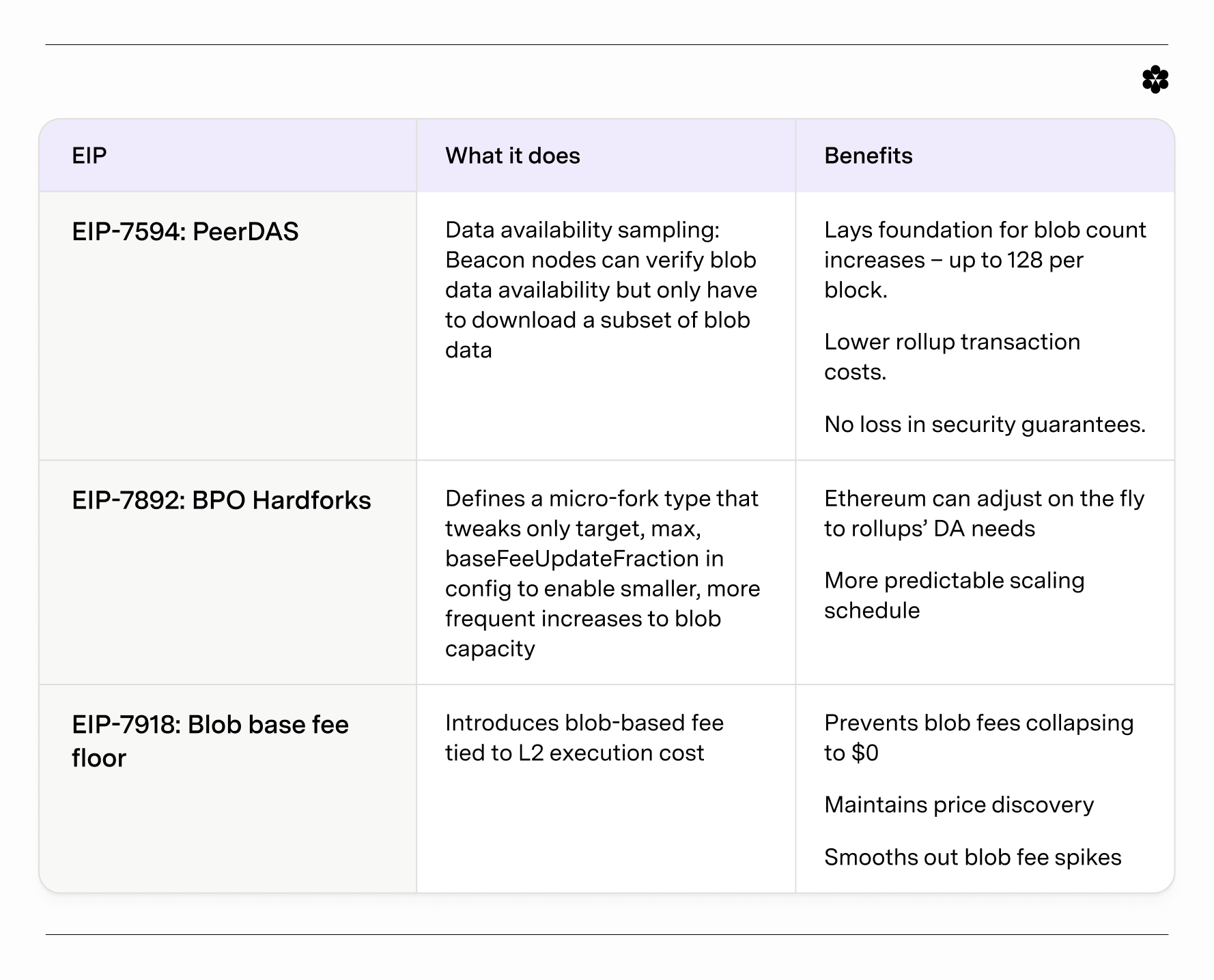
EIP-7594: PeerDAS
PeerDAS brings data availability sampling to the beacon chain so a validator can be confident blobs were published while only fetching small random chunks, which slashes bandwidth and removes the need for every node to download every byte of DA. Under the hood it relies on erasure coding and sampling theory so the network can raise blob capacity in measured steps without sacrificing honest-majority security. In practice, this is the consensus prerequisite for cheaper L2 DA and staged increases toward the long-term roadmap of dozens of blobs per slot, roughly in the neighborhood of 128 at maturity, with rollups inheriting lower and more predictable costs as capacity rises.
EIP-7892: Blob-Parameter-Only (BPO) hardforks
BPO defines a tiny, purpose-built fork that changes only three knobs in client configs: The blob target, blob max, and the baseFeeUpdateFraction that controls fee responsiveness, so Ethereum can adjust DA supply frequently without bundling unrelated changes or waiting for a full network upgrade. Because the scope is intentionally narrow, coordination risk is lower, reversibility is higher, and Core Devs can iterate quickly to match real rollup demand while keeping blob price dynamics stable rather than lurching between scarcity and glut.
EIP-7918: Blob base-fee floor
This couples the blob fee to execution gas by adding a floor, closing the corner case where blobs become effectively free during lulls and then spike when demand returns. By anchoring blob fees to a familiar cost baseline, the policy dampens volatility, discourages opportunistic timing games by rollups, and sustains healthy price discovery even as capacity increases via BPO, all without hard-coding a fixed minimum that could age poorly as L1 economics evolve.
Gas economics and block sizing
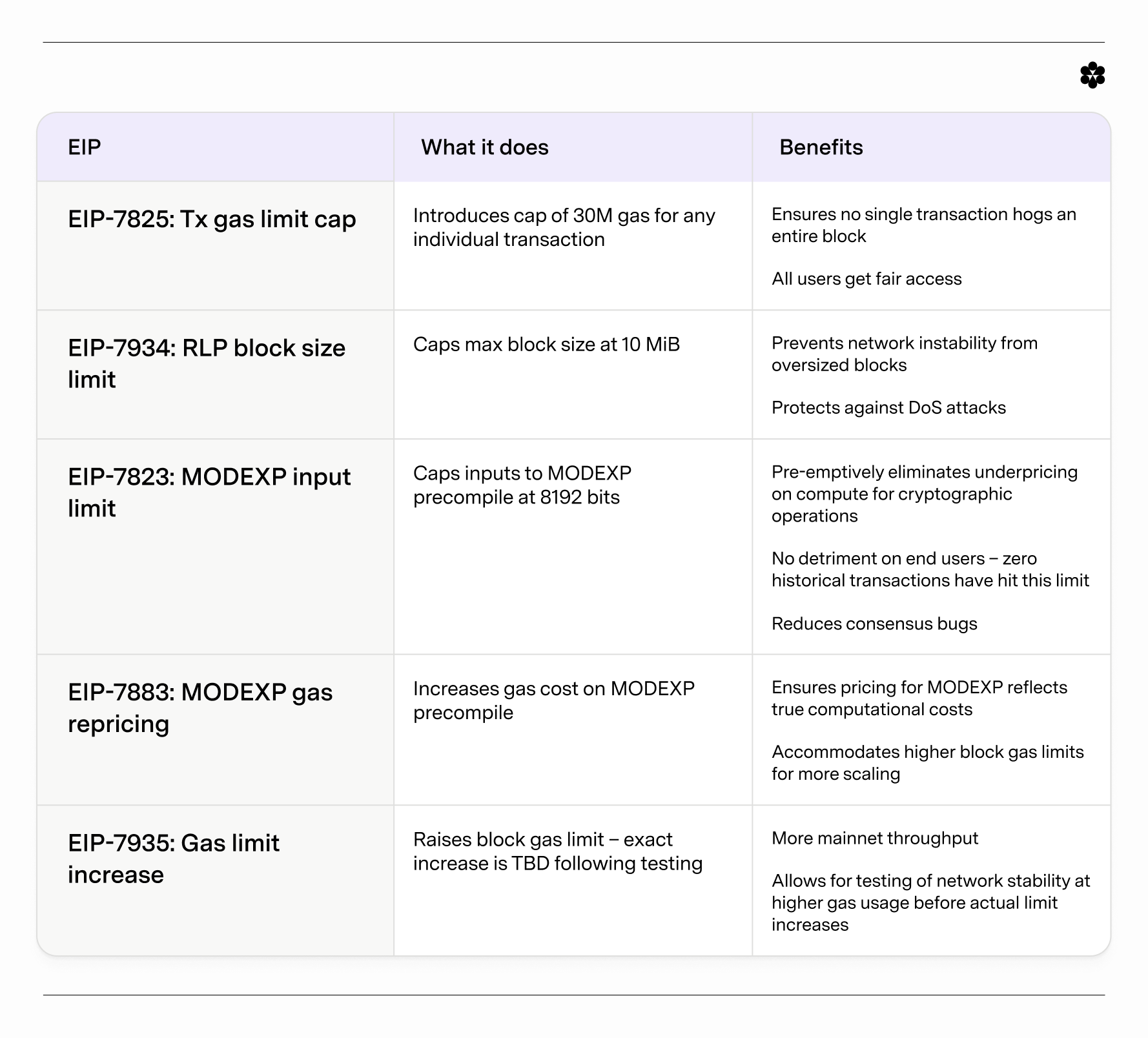
EIP-7825: Per-transaction gas cap
A single transaction is capped at 16,777,216 gas, which prevents any one payload from monopolizing a block as client defaults climb. This keeps validation time bounded, improves worst-case propagation, and nudges heavy apps to split work into batch-friendly chunks or rollup-side execution. Historically, almost all mainnet transactions already sit below this threshold, so the cap functions as a safety rail for future throughput rather than a constraint on today’s usage.
EIP-7934: RLP execution block size limit
Gas measures computation but not bytes, so EIP-7934 places a hard 10 MiB ceiling on the RLP-encoded execution block to close DoS edges where large but cheap payloads stress networking. The byte cap aligns block gossip with what clients can reliably propagate within slot time, complements the per-tx gas cap and DA work, and gives operators a clear, audit-able bound that is independent of how calldata-heavy or witness-dense a block becomes.
EIP-7823: MODEXP input limit
MODEXP underpins RSA and some niche crypto, and pathological inputs can create outsized CPU loads, so this EIP caps each of the three inputs (base, exponent, modulus) at 8192 bits. The bound is well above real-world needs, leaves historical usage untouched, and gives implementers freedom to optimize big-integer code paths without guarding against effectively unbounded sizes, which reduces consensus divergence risk during client upgrades.
EIP-7883: MODEXP gas repricing
Alongside the new size limits, MODEXP is repriced so gas paid maps more closely to actual work across clients and hardware, removing a long-standing underpricing vector. The updated cost model scales with input bit lengths to eliminate cheap-to-pay, expensive-to-verify transactions, which clears a necessary bottleneck before lifting block gas defaults and makes cryptographic protocols that rely on modular exponentiation pay a fair share of resources.
EIP-7935: Default block gas limit increase
Clients raise their default block gas limit to a higher value by configuration (targeted at 60M in testing), which is not a consensus rule but a widely coordinated operator move. Framed this way, throughput increases can roll out conservatively, with room to watch propagation, peer health, and mempool behavior under real load. The earlier caps and byte limits act as guardrails so operators can adopt the new default with fewer tail-risk surprises.
Validator UX
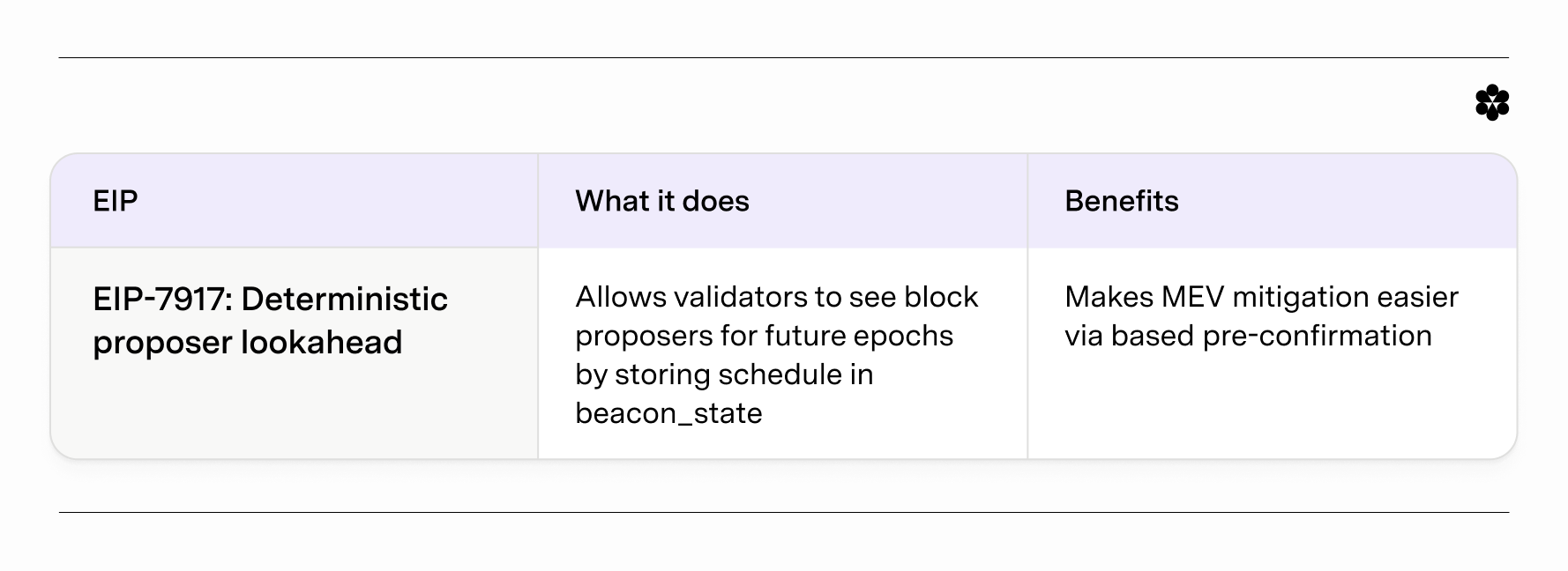
EIP-7917: Deterministic proposer lookahead
By committing the next-epoch proposer schedule into beacon_state, the network makes “who proposes when” verifiable from the beacon root, which is a clean primitive for pre-confirmation markets, builder commitments, and MEV-aware designs that need credible timing guarantees. Offchain infra can plan, onchain apps can verify with a Merkle proof, and researchers get a simpler surface to reason about based-precon mechanisms without bespoke side channels.
EVM and cryptography
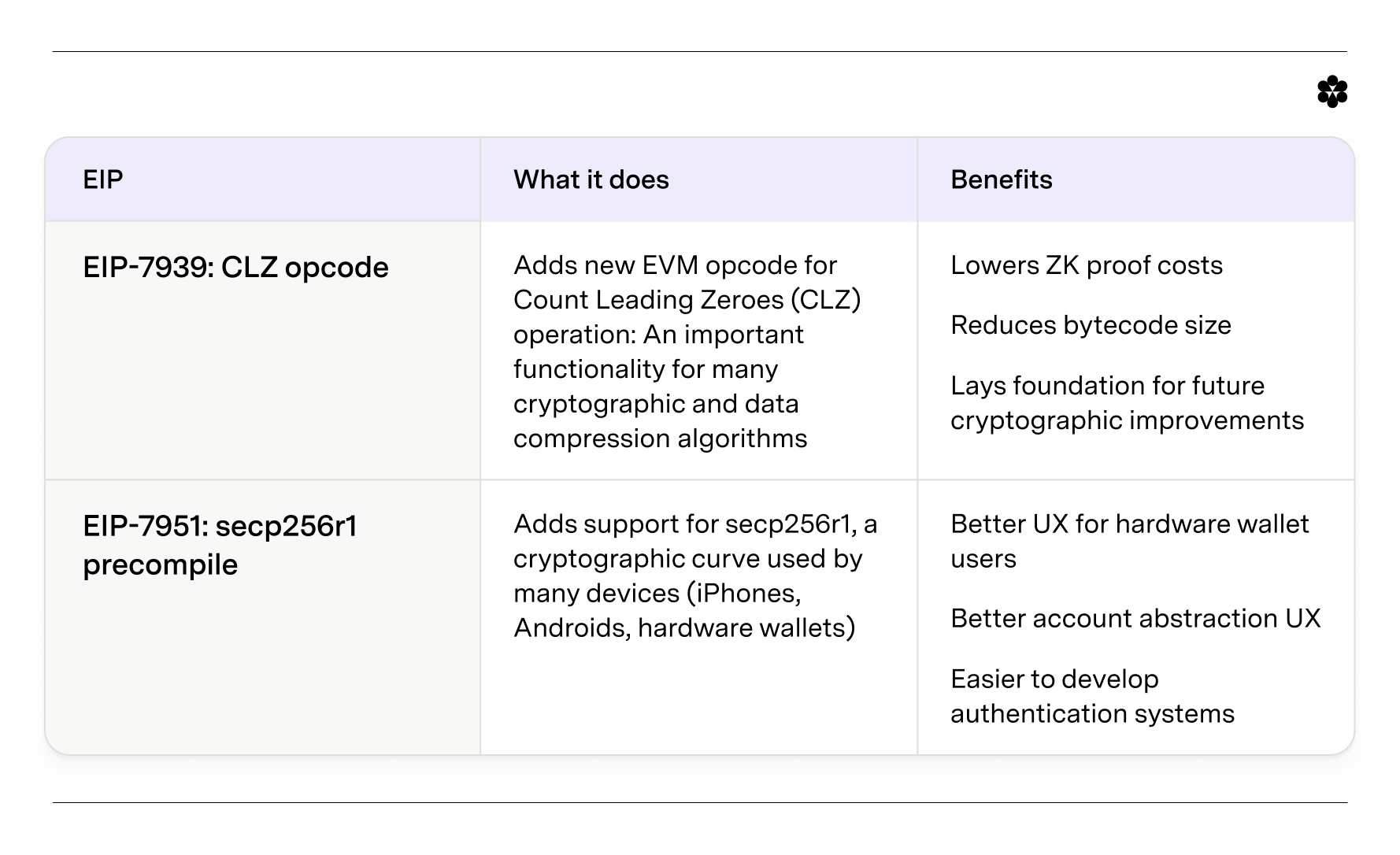
EIP-7939: CLZ opcode
CLZ adds a first-class operation to count leading zero bits in a 256-bit word, a tiny change with outsized utility: libraries can compute bit lengths without branching tricks, normalize field elements in big-int arithmetic, implement fast priority queues or prefix codes, and streamline ZK gadgets that previously emulated CLZ in bytecode. Contracts shrink, gas for common patterns drops, and compiler backends get a straightforward target for low-level optimizations.
EIP-7951: secp256r1 precompile
A native precompile for P-256 signature verification aligns Ethereum with WebAuthn passkeys and the secure elements that ship on iOS, Android, and many hardware modules, so wallets and account-abstraction flows can lean on device-native credentials without awkward bridges to secp256k1. The result is simpler code, predictable gas for verification, and a smoother path to passwordless auth in dapps and L2s, while leaving existing secp256k1 accounts and tooling untouched.
Networking and ops
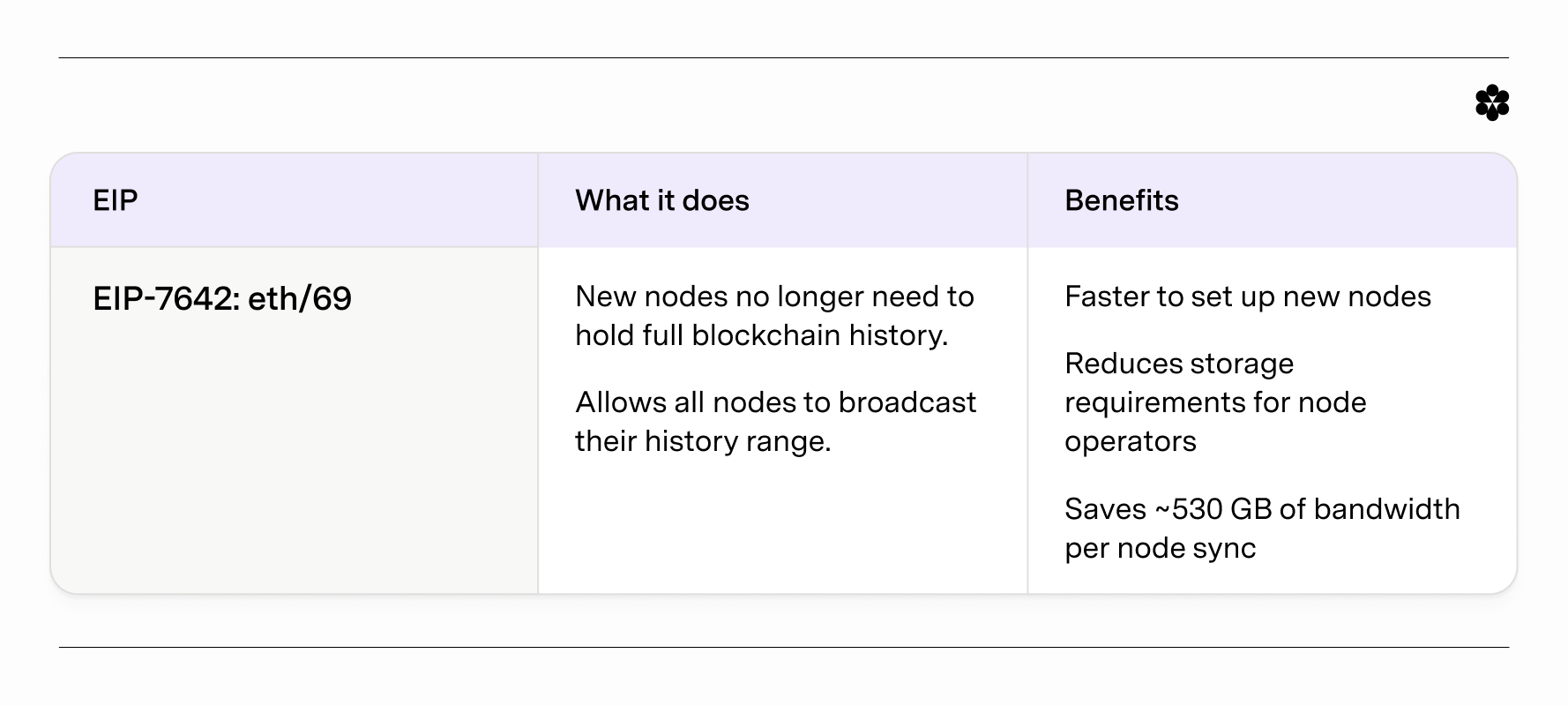
EIP-7642: eth/69 networking update
The eth/69 upgrade modernizes the execution-layer p2p protocol by letting nodes advertise which history ranges they actually serve and by trimming legacy receipt fields like blooms from the wire format, pairing neatly with history-expiry efforts. Fresh nodes sync faster, operators push fewer useless bytes, and full sync bandwidth drops by hundreds of gigabytes per node on today’s chain size, which translates to lower bootstrapping friction and healthier peer graphs as the network grows.
Fusaka focuses on safe, steady growth.
It makes data cheaper and more predictable, sets clear limits so blocks do not get overloaded, and trims extra bloat from both apps and nodes. For builders, that means lower and steadier costs, fewer weird edge cases, and simpler features like passkey sign-in. For operators, it means faster syncs, clearer guardrails, and the option to turn up throughput once monitoring looks good. In short, fewer surprises and more room to build.